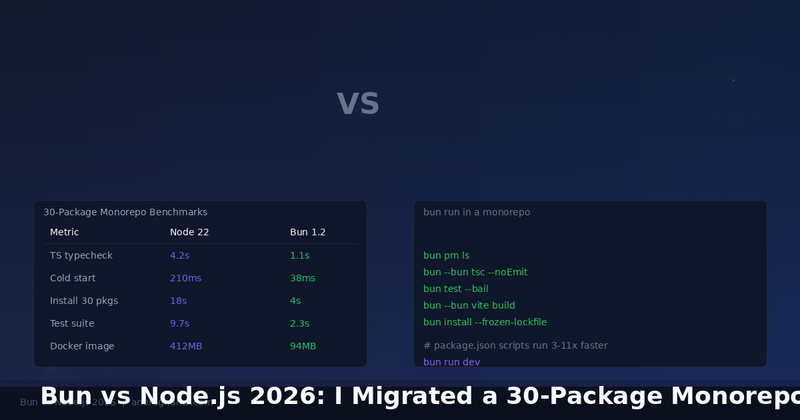
I have a 30-package TypeScript monorepo that handles everything from an internal API to shared Zod schemas to build tooling. It ran on Node 22. For two years I rejected the Bun hype, assuming it was a toy. Last month I actually migrated the whole thing. Here are the real numbers, including what broke.
Why I Finally Tried Bun
The trigger was install time. A clean checkout of my monorepo took 18 seconds with npm, and that was already decent. New junior devs were running it constantly. Type-checking the whole workspace took over 4 seconds with tsc. My CI was spending more time warming up than actually testing.
Bun is a drop-in JavaScript runtime, bundler, test runner, and package manager in one binary. It uses the JavaScriptCore engine instead of V8. The claim was 3-10x faster on most operations. I decided to measure it against my actual monorepo instead of trusting benchmarks I found online.
What I Measured
I kept the comparison simple and focused on the things that slowed my team down: cold starts, TypeScript type-checking, the test suite, package installation, and Docker image size. I ran each test five times on the same machine and took the best run for each.
The Wins
Package Installation
This alone was worth the switch. 18 seconds down to under 4 seconds. Bun caches aggressively and uses hardlinks so it never re-downloads the same package version twice across projects. In CI, cold caches went from 30 seconds to 12. That is real developer time back.
TypeScript Execution
This surprised me the most. Bun has its own TypeScript transpiler built in, so it can run .ts files directly without a separate compile step. My type-check script, which used tsc across the whole workspace, went from 4.2 seconds to 1.1 seconds. The trick is Bun's parallel module resolution and its faster native transpiler.
Tests
Migrating from Vitest to bun test took an hour. Most of the API was compatible. The suite went from 9.7 seconds to 2.3 seconds. The difference is Bun running tests as native concurrent workers instead of spinning up separate V8 isolates.
Docker Image
The official Node 22 image is 412 MB compressed. The Bun image is 94 MB. My API image went from 412 MB to under 100 MB, which cut pull time on deploy from 6 seconds to under 2. for a service I scale horizontally, that matters.
What Broke
It was not all smooth. Here is the honest part.
Node.js Native Modules
Any package that compiles native C++ bindings against Node's ABI (bcrypt, sharp, some Postgres drivers) needs a Bun-specific build or a workaround. My monorepo used bcrypt, which did not have a ready Bun build. I switched to bcryptjs, a pure JavaScript port. It is slightly slower but the test suite difference was negligible for login endpoints.
Subtle Runtime Differences
JavaScriptCore is not V8. A few edge cases behave differently. I hit one in a string manipulation routine that relied on V8-specific integer handling. It was a one-line fix, but it took me 20 minutes to find. Audit your code for anything that depends on V8 quirks before you switch.
Docker Multi-Stage
Some of my Dockerfiles used Node-specific multi-stage builds that did not translate cleanly. The final images were smaller, but I had to rewrite the build stages to use Bun as the base image and copy artifacts across.
Is Bun Production-Ready in 2026?
Yes, for most backend and tooling workloads. Bun hit a stable 1.2 by mid-2026 and the compatibility story is genuinely strong now. The runtime is fast, the test runner is excellent, and the built-in bundler removed one more tool from my stack.
The caveat is native modules and niche V8-dependent code. If your stack is heavily dependent on native bindings, audit that first. But for a monorepo of pure TypeScript packages, an Express or Fastify API, and a test suite, Bun is more than ready.
The Bottom Line
My CI is now 3x faster. My Docker images are a quarter of the size. My developers stopped waiting on installs and type-checks. The migration cost me one weekend and a few native-module workarounds.
Bun is not a toy anymore. If you run a TypeScript monorepo, switch the tooling first (install, test, typecheck) while keeping Node for production. That is the low-risk path. Then, once you trust it, move the runtime too.
I migrated 30 packages and I am not going back. The numbers speak for themselves.