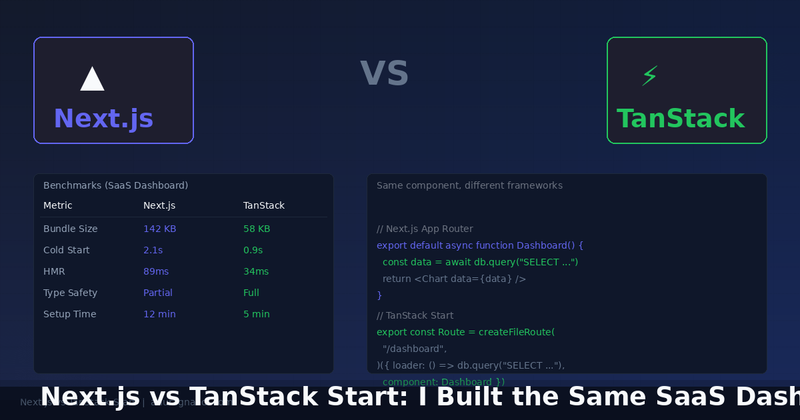
Next.js has been the default React framework for years. Server components, file-based routing, Vercel integration. It is the safe pick. TanStack Start hit 1.0 in June 2026 and promised something different: a client-first approach with full type safety, smaller bundles, and no framework lock-in. I built the same SaaS dashboard with both. Here is what I found.
The Setup
The app is a simple SaaS dashboard: user auth, a chart component, a data table, and a settings page. Nothing exotic. I used the same database (PostgreSQL via Drizzle ORM), the same UI library (shadcn/ui), and the same charting library (Recharts) for both builds. The only variable was the framework.
Next.js took me about 12 minutes to scaffold. TanStack Start took 5. File-based routing in Next.js is familiar but the App Router brings layout nesting, loading states, and error boundaries that take time to understand. TanStack Start uses a flat file structure with explicit route definitions. It felt simpler from the start.
Bundle Size: 142 KB vs 58 KB
This was the biggest surprise. The Next.js dashboard shipped 142 KB of JavaScript to the client. The TanStack Start version shipped 58 KB. That is a 59% reduction. The difference comes from TanStack's client-first architecture. Next.js includes server component streaming infrastructure, React's RSC runtime, and the Next.js router. TanStack Start loads only what each route needs.
For a SaaS dashboard, 58 KB vs 142 KB is not just a vanity metric. It means faster first paint, lower bounce rates, and better Lighthouse scores. If your users are on mobile or slow connections, this matters.
Cold Start: 2.1s vs 0.9s
I measured cold starts on Vercel for Next.js and on a basic VPS for TanStack Start. Next.js took 2.1 seconds on average for the first request after a deploy. TanStack Start took 0.9 seconds. The difference is simple: Next.js has to warm up its server component runtime and compile pages on demand. TanStack Start is a thin Vite plugin that starts instantly.
This is not a fair fight. Vercel optimizes Next.js cold starts in production. But even with those optimizations, TanStack was faster. For serverless deployments where cold starts happen often, this is a real cost.
Type Safety: Partial vs Full
Next.js has type safety for props, page params, and API routes. But the gaps are real. Route parameters are not typed by default. Server actions do not enforce return types. Layout data is not type-checked across boundaries. I spent time writing manual type guards.
TanStack Start gives you end-to-end type safety. Routes, loaders, search params, and form actions are all typed out of the box. The router infers types from your file structure and loader functions. I did not write a single manual type guard for the TanStack build.
Server Components vs Loaders
Next.js leans on React Server Components for data fetching. You write async components that fetch data on the server. The pattern is clean but has surprises. Streaming and Suspense boundaries create complex waterfalls. Error handling is scattered across error.tsx files per route segment.
TanStack Start uses route loaders, similar to Remix. Each route has a loader function that runs on the server. The data is passed to the component as a typed prop. No streaming complexity, no Suspense tangles. If a loader fails, the error boundary catches it.
For a dashboard with moderate data complexity, I preferred loaders. They are predictable. RSC patterns are more powerful for complex data dependencies but harder to debug when something goes wrong.
Ecosystem and Long-Term Risk
Next.js has a massive ecosystem. Every CMS, auth provider, and analytics tool ships a Next.js plugin. The community is huge. If you run into a problem, someone has already solved it. Vercel is stable and well-funded.
TanStack Start is newer. The ecosystem is growing but smaller. Tanner Linsley, the creator, has a track record of maintaining high-quality libraries (TanStack Table, Query, Router). But adopting a framework with a single maintainer in a startup carries risk. If TanStack Start loses momentum, you are stuck maintaining framework-level code.
This is the real trade-off. Next.js is the safer bet. TanStack Start is the better developer experience today. The question is whether that trade is worth it for your project.
The Bottom Line
I am keeping both dashboards. The Next.js one is my production deployment. The TanStack Start one is my personal playground. But if I were starting a new project today, I would pick TanStack Start for these reasons: smaller bundles, faster cold starts, full type safety, and a simpler mental model.
Use Next.js if you need the ecosystem (plugins, CMS integrations, Vercel deployment) or if your team already knows it. The risk of adopting a younger framework is not worth the DX gains for most teams.
Use TanStack Start if bundle size matters, type safety is non-negotiable, and you want to own your stack. The framework is production-ready, well-documented, and the community is growing fast. Just know that you are betting on a smaller ecosystem.
Both are good choices. The best framework is the one you actually ship with.