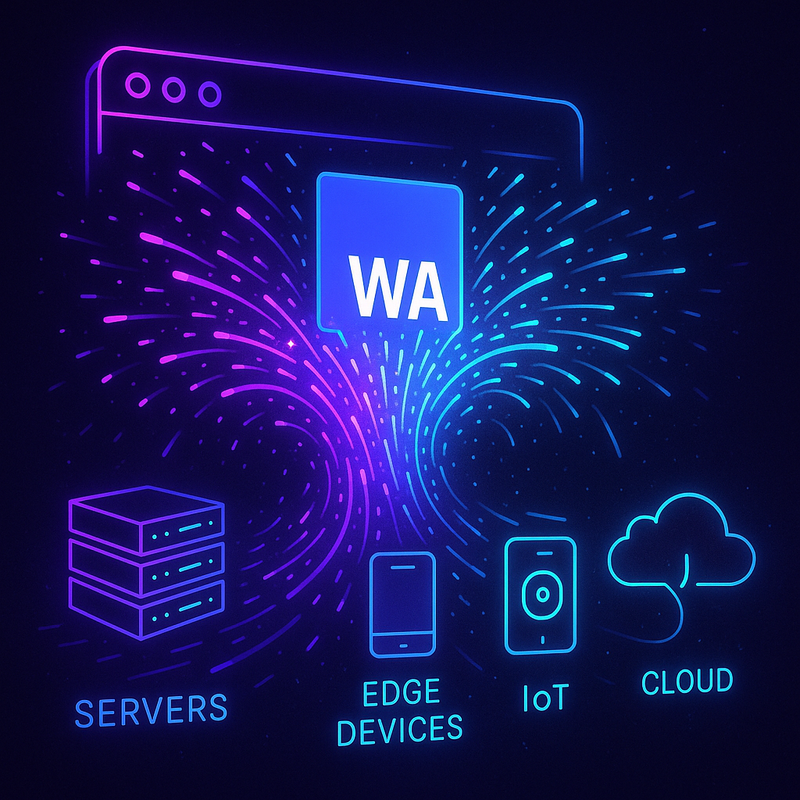
Here's something most web developers don't realize: WebAssembly is quietly becoming the next major server-side runtime. Not in the browser. On servers, at the edge, in IoT devices, and inside container orchestrators. And it's happening faster than most people think.
Docker's co-founder Solomon Hykes said it in 2019: "If WASM+WASI existed in 2008, we wouldn't have needed to create Docker." In 2026, that quote is aging like fine wine.
What Is WASI and Why Should You Care?
WASI (WebAssembly System Interface) is what lets WebAssembly run outside the browser. Think of it as a standard API that gives Wasm modules access to files, network sockets, clocks, and environment variables — things you need to build real applications, not just browser widgets.
Without WASI, WebAssembly is sandboxed to pure computation. With WASI, it becomes a universal binary format that runs anywhere — any OS, any architecture, any environment.
The roadmap has progressed rapidly:
WASI Preview 1 — filesystem access only. The proof of concept.
WASI 0.2 (Preview 2) — networking, HTTP, sockets. The "actually useful" release.
WASI 0.3 — native async support. Currently experimental but already running production workloads.
And the Component Model — a spec that lets you compose Wasm modules written in different languages into a single application — is what ties it all together. Write your HTTP handler in Rust, your business logic in Go, your templating in Python, and they all link together at the Wasm level.
Who's Actually Using This in Production?
This isn't theoretical. Real companies are running Wasm on servers today:
Cloudflare Workers
330+ global edge locations. Every Cloudflare Worker can run WebAssembly. When you deploy a Worker, your code starts in microseconds — not milliseconds, microseconds. Compare that to a cold-start Lambda function at 200-500ms. For latency-sensitive applications like A/B testing, auth, or API gateways, this is a game-changer.
Fermyon Spin (Now Backed by Akamai)
Fermyon built Spin, a framework specifically for building serverless WebAssembly applications. Akamai acquired Fermyon to power their edge computing across 4,000+ global locations. Spin apps start in microseconds, use megabytes of memory (not gigabytes), and can handle 75 million requests per second on their platform.
Fastly Compute
Fastly's edge computing platform runs Wasm natively. They report microsecond-level instantiation times. Major sites use it for edge-side request routing, personalization, and security filtering — all running WebAssembly.
American Express
AmEx runs an internal Functions-as-a-Service platform built on wasmCloud that uses Wasm for their microservices. The Component Model lets their teams write services in whatever language they prefer while maintaining a unified deployment pipeline.
Docker
Docker now supports 7 different Wasm runtimes. You can run Wasm containers alongside traditional Linux containers in the same Docker Compose stack. The Wasm containers are smaller (often under 10MB vs hundreds of MB for Linux containers) and start near-instantly.
The Numbers: Wasm vs Containers
Here's why the industry is paying attention. These are real-world comparisons:
| Metric | Docker Container | Wasm Module |
| Cold start time | 200-500ms | 1-5ms |
| Image size (simple API) | 150-500MB | 2-10MB |
| Memory overhead | 50-200MB | 5-20MB |
| Startup to first request | 1-3 seconds | <10ms |
| Sandboxing | Process-level (shared kernel) | Bytecode-level (no kernel access) |
| Cross-platform | Rebuild per architecture | Single binary runs everywhere |
The security model alone is compelling. A Docker container shares the host kernel and has broad default capabilities. A Wasm module can only do what you explicitly grant it — no filesystem access unless you say so, no network unless you say so, no environment variables unless you say so. It's deny-by-default.
Where Wasm on the Server Makes Sense
Edge Computing
This is the killer use case. When your code needs to run in 300+ locations globally with microsecond startup, Wasm is the only realistic option. Node.js and Python are too slow to cold-start. Containers are too large to distribute globally.
Real use cases: A/B testing at the edge, request routing and authentication, image optimization and resizing (no more round-trips to origin), personalization and geo-targeting, API rate limiting and WAF rules.
Serverless Functions
The cold start problem has plagued serverless from the beginning. AWS Lambda in Node.js cold-starts in 200-800ms. A Wasm function cold-starts in under 5ms. For event-driven architectures where functions spin up and down constantly, this is transformative.
Plugin Systems
If you build a platform that accepts user-submitted code (think Shopify Functions, Figma plugins, or game modding), Wasm gives you a sandboxed execution environment. The user's code literally cannot access anything you don't explicitly grant. Shopify already uses this — their Shopify Functions run merchant code in Wasm.
IoT and Embedded
Wasm modules can run on devices with as little as 256KB of memory. Atym, an edge computing company, runs Wasm containers on embedded devices that are too small for Docker. When you need to push code updates to 10,000 edge devices simultaneously, shipping a 5MB Wasm module beats a 500MB container image.
Where Wasm on the Server Is NOT Ready Yet
Let's be honest about the gaps:
Ecosystem maturity. The npm/pip/cargo ecosystems are massive. WASI libraries are growing but still limited. You might find that the specific database driver or SDK you need doesn't have a Wasm build yet.
Debugging. Tooling has improved but still lags behind what you get with Node.js or Python. Source maps work, but breakpoint debugging in a Wasm module isn't as smooth as debugging JavaScript in Chrome DevTools.
Raw I/O performance. For I/O-heavy workloads (lots of database queries, file reads), Wasm doesn't offer advantages over Node.js. The bottleneck is the I/O, not the compute.
Team knowledge. If your team writes JavaScript, adopting Rust for Wasm modules is a real learning curve. AssemblyScript helps bridge this gap, but it's not as performant as Rust-compiled Wasm.
Getting Started: Your First Server-Side Wasm App
The fastest way to try this is with Fermyon Spin. You can build and deploy a complete HTTP API in about 10 minutes:
Yes, that's JavaScript running in a Wasm runtime on the server. You don't have to learn Rust to start with server-side Wasm. Start with what you know, then optimize the hot paths in Rust later if you need to.
The Bigger Picture: Where This Is Heading
WebAssembly in 2026 is where containers were in 2015 — proven technology that's crossing from early adopters to mainstream. The trajectory is clear:
Short term (now): Edge computing and serverless. Cloudflare, Fastly, Fermyon/Akamai are already here.
Medium term (2026-2027): Plugin systems and multi-tenant platforms. Any SaaS that runs user code will consider Wasm.
Long term (2028+): General purpose server workloads. When WASI matures and the ecosystem fills in, Wasm containers could replace Docker for many use cases.
I'm not saying Docker is dead — that would be like saying JavaScript is dead because of Wasm. But for specific workloads, especially at the edge and in serverless, Wasm is already better. And the gap is widening.
The best time to start learning this was two years ago. The second best time is now.